

The Physics of Power Storage
As current flows through coiled wire, magnetic fields spring to life. When current stops, collapsing fields release stored energy—a phenomenon Faraday discovered in 1831 that now enables wireless charging. Modern high-performance inductors like amorphous cores leverage unique atomic structures of iron/cobalt alloys to reduce hysteresis losses by 50%, maintaining stability even at 200kHz frequencies.
Breakthrough Insight: Where traditional ferrites degrade above 100°C, automotive-grade amorphous inductors (e.g., AMSA series) maintain <15% inductance loss at 150°C withstanding engine vibrations—ensuring EV charging reliability.
Evolution: From Telegraph Relays to 6G
19th-century inductors weighed hundreds of kilograms (like telegraph relays); today’s 01005-format inductors measure just 0.4mm. Three material revolutions enabled this miniaturization:
- Ferrite Era (1950s): Affordable but prone to saturation, limiting power density
- Powder Core Revolution (1990s): Sendust alloy cores boosted high-frequency performance for early switch-mode power supplies
- Amorphous/Nanocrystalline Leap (2010s-): AMOGREENTECH’s iron-based AMSN cores achieve 63% lower loss vs. ferrites at 200kHz while shrinking size by 40%
Silencing Electronic Noise
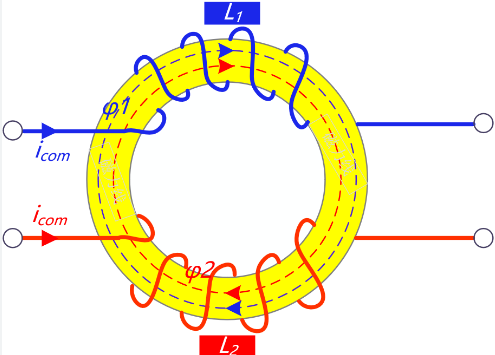
Ever wonder why your WiFi survives microwave interference? Thank common-mode chokes in power adapters. Their dual-coil design acts as a "magnetic canceller": noise self-destructs within the core while useful current flows freely. Chemi-Con’s SM-series amorphous chokes—AEC-Q200 certified—reduce automotive inverter EMI to microtesla levels (1/1000th of Earth’s magnetic field).
Real-World Case: Tesla Model 3’s battery management system uses distributed inductor networks to suppress 200A current-switching surges, protecting BMS chips from voltage spikes.
Frontiers: Quantum Materials Redefine Possibilities
In 2024, MIT created the first room-temperature superconducting inductor using topological insulators. While commercialization remains distant, amorphous innovations push boundaries today:
- 3D Integration: TDK embeds thin-film inductors directly into CPU power layers, halving current paths
- Smart Response: AMOTECH’s AMP-series uses temperature-sensitive alloys to auto-increase impedance as "magnetic fuses" during overloads
- Biomedical Advances: Degradable iron-core inductors power pacemakers for 3 months before dissolving—eliminating removal surgery
Challenges & Emerging Solutions
Rare-earth scarcity drives up costs (cobalt-based amorphous cores cost 8× ferrites). Yet breakthroughs emerge:
- Cellulose Nanocrystal Cores: Osaka University synthesizes eco-magnetic cores from wood pulp, cutting carbon footprint by 90%
- Superconducting Control: Liquid-nitrogen-cooled YBCO coils in MRI machines achieve zero-resistance energy storage, slashing power use by 70%
While "chip independence" dominates headlines, passive components like inductors remain strategically vital. A single 5G phone uses 70 inductors—yet China imports >60% of amorphous cores. This silent tech battle rages within millimeter-scale magnetic hearts.
Inductors are the "respiratory system" of electronics—invisibly regulating energy to sustain technological life. They never seek recognition, yet with every current surge and collapse, they redefine what’s possible.
