
Why Your Gadgets Fight Each Other: The EMI Crisis
Electronic devices emit electromagnetic 'noise' like invisible chatter—when your phone distorts car radio signals or a drone disrupts Wi-Fi, that’s EMI (Electromagnetic Interference). Unshielded inductors amplify this chaos, leaking magnetic fields that degrade system performance by up to 70%. In critical applications like EV battery management or ICU medical devices, uncontrolled EMI risks safety failures and compliance violations (e.g., FCC Part 15).
Key stats:
-
78% of automotive ECU malfunctions trace to EMI from power inductors.
-
5G base stations lose ~15% signal clarity due to cross-circuit interference.
The Silent Guardian: How Magnetic Shielding Works
Image suggestion: A 3D cutaway of a shielded inductor showing: ferrite core (gray), copper coils (orange), and magnetic shielding can (blue). Label flux lines confined inside the shield versus leakage in unshielded designs.
Core Physics: Containing the "Invisible Storm"
Shielded inductors trap magnetic fields using two principles:
-
Closed magnetic pathways: Nickel-zinc ferrite shells (e.g., Ni₀.₅Zn₀.₅Fe₂O₄) redirect flux lines inward, reducing stray fields by 90% vs. air-core designs.
-
Lenz’s Law in action: Current changes generate counter-electromotive forces (back-EMF), suppressing high-frequency noise.
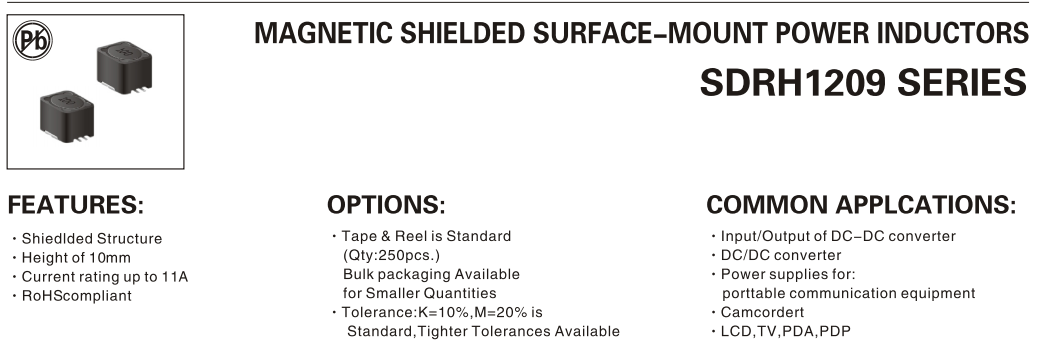
Example: In a 48V DC-DC converter, unshielded inductors emit fields spanning 10cm—enough to disrupt sensors. Shielded versions (e.g., SDRH1209) confine fields within 2mm.
SDRH in Action: Real-World EMI Solutions
Image suggestion: Comparison table: SDRH series vs. unshielded inductors. Columns: Series | Max Current | EMI Reduction | Key Applications. Highlight SDRH8D43 (6.4A) and SDRH1209 (11A).
| Application | Problem | SDRH Solution | Result |
|---|---|---|---|
| EV onboard charger | Engine noise corrupting CAN bus signals | SDRH8D43 (2μH, 6.4A) + Mu-metal can | EMI ↓64%, meets CISPR 25 Class 5 |
| 5G mMIMO antenna | Crosstalk between RF chains | SDRH10145 (100μH, 1.1A) | Noise floor ↓8dB, SNR gain >3dB |
| Wearable ECG monitor | Motion sensors distorting biosignals | SDRH0603 (10μH, 1.7A) | Baseline wander eliminated |
Design advantage: Flat-top coils (e.g., SDRH0704) enable robotic pick-and-place assembly, cutting production costs by 25%.
Engineer’s Cheat Sheet: Selecting Shielded Inductors
Image suggestion: Annotated cross-section of a PCB layout showing: Input noise → Shielded inductor → Clean output. Callouts: IDC margin, SRF, and DCR.
Avoid These Traps:
-
❌ "Higher inductance = better": Oversized coils saturate faster. Example: A 22μH inductor may throttle at 0.5A vs. a 10μH unit handling 2A.
-
❌ Ignoring SRF: Operating above self-resonant frequency turns inductors into capacitors.
3-Step Selection Protocol:
-
Current check:
-
IDC_min = 1.3 × I_peak(e.g., 3.9A for 3A load).
-
Use SDRH12575 (8.2A) for motor drivers; SDRH3D16 (1.8A) for IoT sensors.
-
-
Size constraints:
-
≤1.8mm height: SDRH0603 (wearables)
-
High power: SDRH104 (10A, 10.4×10.4mm).
-
-
Certifications:
-
Automotive: AEC-Q200 (SDRH1209)
-
Medical: ISO 13485 (SDRH4D28)
-
Future Frontiers: Nano-Crystals and GaN Integration
Image suggestion: Concept art: Nanocrystalline core structure (hexagonal lattice) next to a GaN power IC with integrated inductor.
Next-Gen Breakthroughs:
Nano-crystalline cores: Amorphous alloys (Fe-Si-B) slash core losses by 40% at 1MHz+ frequencies, enabling micro-server PSUs.
Embedded passives: Intel’s PCB-integrated inductors reduce footprint by 60% for AR/VR headsets.
GaN synergy: SDRH-GaN hybrid modules (e.g., 650V/100kHz) boost efficiency to 98%, cutting thermal stress.
Conclusion: Design Smarter, Shield Smarter
Magnetic shielding isn’t just noise control—it’s system integrity. From EVs to edge AI, optimized inductor selection ensures reliability in an EMI-choked world.
